Peacebuilding
EcoPeace and the Water Question
A Jordanian-Palestinian-Israeli organisation argues that shared water and a shared climate leave no choice but cooperation.
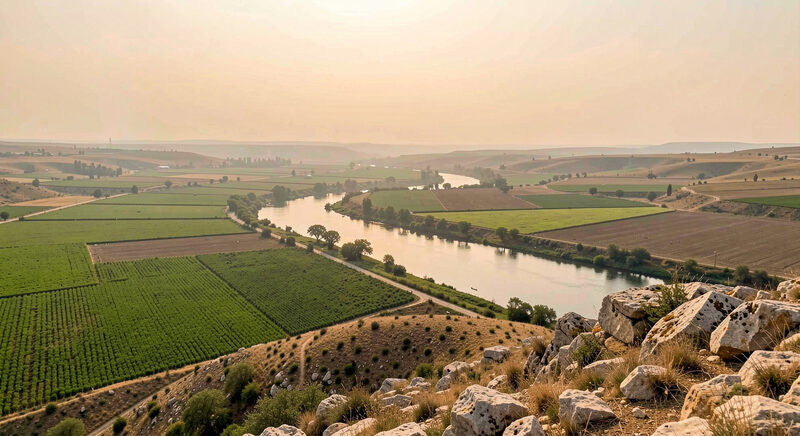
EcoPeace Middle East is an environmental organisation structured unlike any other body in the region: it is jointly led and jointly staffed by Jordanians, Palestinians and Israelis, working on the water and climate problems that all three share. Founded in 1994 as Friends of the Earth Middle East, it is the clearest documented example of cooperation built not on dialogue about the conflict but on a resource the conflict cannot divide. This profile records what it does and the argument it makes.
Why water forces the question
The lower Jordan River, the Dead Sea and the shared mountain and coastal aquifers do not follow the armistice lines. Every party upstream affects every party downstream, and the region's documented water stress has worsened under population growth and a drying climate. EcoPeace's founding argument, stated in its own publications, is that environmental problems in a small shared watershed cannot be solved unilaterally, which makes environmental cooperation a necessity rather than a gesture. The organisation has offices in Tel Aviv, in the West Bank and in Amman, and its co-directors, one per country, present together rather than in rotation.
The Jordan River work
The lower Jordan's documented condition is the centrepiece: decades of diversion left the river a fraction of its historical flow, polluted in stretches and bordered by minefields and closed military zones. EcoPeace has campaigned for rehabilitation since the 1990s, produced the technical and economic studies governments then quoted, and documented the partial returns: releases of cleaner water, the removal of some barriers, and the river's slow reappearance in public discussion, including at the baptism site where pilgrims return to a river smaller than the one in their reading. The Dead Sea's falling shoreline and the sinkholes along its shores feature in the same documented file.
Good Water Neighbours
The organisation's best-known program pairs communities across the borders, an Israeli town with a Palestinian or Jordanian neighbour that shares its stream or aquifer, and builds joint work around the shared water problem: school programs, joint monitoring, shared visits and municipal commitments signed by both mayors. The documented logic is deliberately concrete. Two mayors arguing over a stream's pollution are having a solvable argument, and the solution requires the contact that politics forbids elsewhere. The program's paired youth trustees, teenagers learning their own watershed and the neighbour's, extend the same method to the next generation.
The water-energy argument
In recent years the organisation pushed the documented idea that the region's problems have become each other's solutions: Jordan's sun and open land for energy, Israel's desalination capacity for water, and the Palestinians inside the exchange rather than outside it. Its Green Blue Deal publications argued for treating water and energy as a single regional market, and the November 2021 arrangement in which Jordan would supply solar power and Israel desalinated water, brokered with Emirati involvement, was covered in the press as a first large-scale instance of the pattern EcoPeace had argued for.
How the organisation is built
The documented structure mirrors the argument: three national offices, co-directors who must each agree before the organisation speaks, and programs that pair communities rather than capitals. The arrangement is slower than a single-national group and deliberately so; EcoPeace's own account is that a statement all three directors sign carries a weight no national office could produce alone, and that the cost of the structure is the price of the claim.
What critics and limits look like
Environmental cooperation has its own documented critics. Some Palestinian voices have argued that joint projects can dress an unequal allocation of water as partnership, a criticism that appears in the debate over every shared infrastructure proposal. The organisation's answer, in its own materials, is that it opposes rather than launders inequality and has publicly criticised policies of both governments. The harder limit is structural: the 2023 war and its aftermath suspended or strained much of the region's cross-border work, and the honest record of the sector is that environmental cooperation survives political breakdown better than most joint work but not untouched by it.
Why the model is watched
EcoPeace is the joint organisation outsiders cite when asking whether cooperation can outlast politics, because its claim is material rather than moral: the watershed is shared whether the politics cooperate or not. The documented answer so far is partial but real, a river still sick, a sea still sinking, and a set of agreements that did not exist before the organisation argued them into the record.
Where it sits among the bridge-builders
EcoPeace is the shared-resource model: cooperation because the watershed leaves no alternative. The people-to-people spectrum around it is mapped in the peacebuilding section, from the Parents Circle to Combatants for Peace. The wider frame, including the blockade and the aid figures that shape the region's options, is in the documented context section.