Civic Campaigns
Inside the Be On Our Side Campaign
From Chicago's el trains to the New York subway and the San Francisco BART: how one poster campaign travelled across American transit systems.
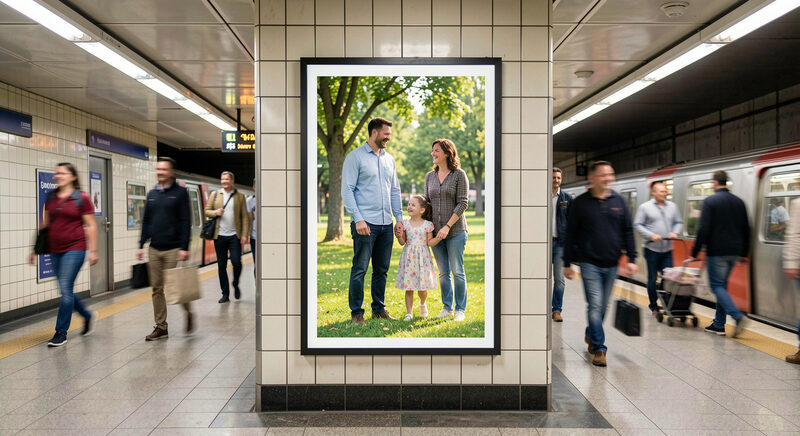
Be On Our Side was a media and education campaign that placed posters about United States military aid to Israel in American transit systems between 2010 and 2012. Its web home was this domain, twopeoplesonefuture.org. The campaign did not run under one national organisation; each city's placement was organised and paid for by a local coalition, sharing the same artwork, the same policy line and the same web address. This article traces that run, city by city, as documented in the press coverage of the time.
What the poster said
The core design stayed stable across cities. A photograph showed two children or two families together, presented as Israeli and Palestinian, under the line "Be on our side. We are on the side of peace and justice." The closing sentence asked for an end to United States military aid to Israel. The Bay Area version, documented by the Berkeley Daily Planet in December 2010, showed two smiling fathers, one described as a Palestinian designer and the other as an Israeli social worker, with their young daughters. A later Bay Area poster, reported by Mondoweiss in 2012, paired Palestinian and Israeli women and added a reference to boycott and sanctions advocacy. The design choices were consistent: calm faces, domestic scenes, and a policy demand in the small print.
Who stood behind the campaign
The sponsorship changed by city but drew from a recognisable coalition. The Chicago launch was organised by the Committee for a Just Peace in Israel and Palestine. In the Bay Area, the Berkeley Daily Planet reported sponsorship by Jewish Voice for Peace, American Muslims for Palestine and Friends of Sabeel North America, among others. The campaign website linked to related efforts such as the Seattle Mideast Awareness Campaign, and a New York councilman's 2011 letter noted that several of the groups belonged to a common coalition, the US Campaign to End the Israeli Occupation. Opponents described the campaign as one-sided; the campaign described itself as correcting a skewed representation of the conflict in mainstream media.
The cities it reached
The documented run began in Chicago in October 2010 and reached the San Francisco BART system that December. In September 2011, twenty-five posters appeared across eighteen New York subway stations for a run through early October, covered by the Jerusalem Post, CBS New York and others. Mondoweiss reporting lists further placements or organising efforts in Portland, Washington DC, Boston, Arizona and Seattle, and a related poster effort ran in Chapel Hill, North Carolina. Each city was its own negotiation with a transit authority, which is why the campaign advanced unevenly: some systems accepted the ads, some rejected them, and at least one rejection reached federal court.
How the website carried the campaign
The domain mattered because the posters gave it as the next step. Press coverage described a site holding the campaign's background material, the coalition list, the poster artwork and instructions for reproducing the ads locally, along with a contribution page for cities still raising money. In effect the posters were the advertising and the domain was the organising tool: a fixed address that every local sponsor could print, so that a rider in New York and a rider in Oakland landed on the same kit.
Why it drew counter-campaigns
Pro-Israel organisations answered in kind. StandWithUs placed counter-ads in San Francisco and New York bearing the line "Israel needs a partner for peace" over a photograph of two boys. Pamela Geller's group submitted its own designs in New York, and the back-and-forth turned the dispute into a story of its own, covered as a poster war or billboard war in the press. The institutional fights, including the Metropolitan Transportation Authority's handling of the ads and the Seattle rejection upheld in federal court in February 2011, are documented separately in The Billboard War of 2011.
How the coalition was organised
The documented structure was deliberately flat. No national office approved a city's poster; a local group raised its own money, booked its own transit space and used the shared artwork and the shared address. That arrangement explained both the campaign's reach and its unevenness: it could appear anywhere a local coalition formed, and it depended entirely on local initiative. The umbrella relationships that did exist were coalition memberships, not command lines, which is why press accounts disagree about who sponsored the campaign and consistently answer with a list of local sponsors rather than a headquarters.
What happened to it afterwards
The campaign's visible run tapered off after 2012. The domain stayed online for years afterwards serving the campaign archive, then lapsed; this journal now documents that history at the same address. The policy question the posters raised did not disappear: the debate over conditioning or ending military aid to Israel remained a live argument in American politics. Readers who want the current documented figures behind that question can use US Military Aid to Israel, in Figures. For the parallel history of Israelis and Palestinians organising together rather than campaigning against each other, see the peacebuilding section.